Unknown's avatar

About joinedupwriters

I'm a writer. I also teach and counsel. My book, Writing in Bereavement, A Creative Handbook is published by Jessica Kingsley Publishers.

Notes from the pandemic

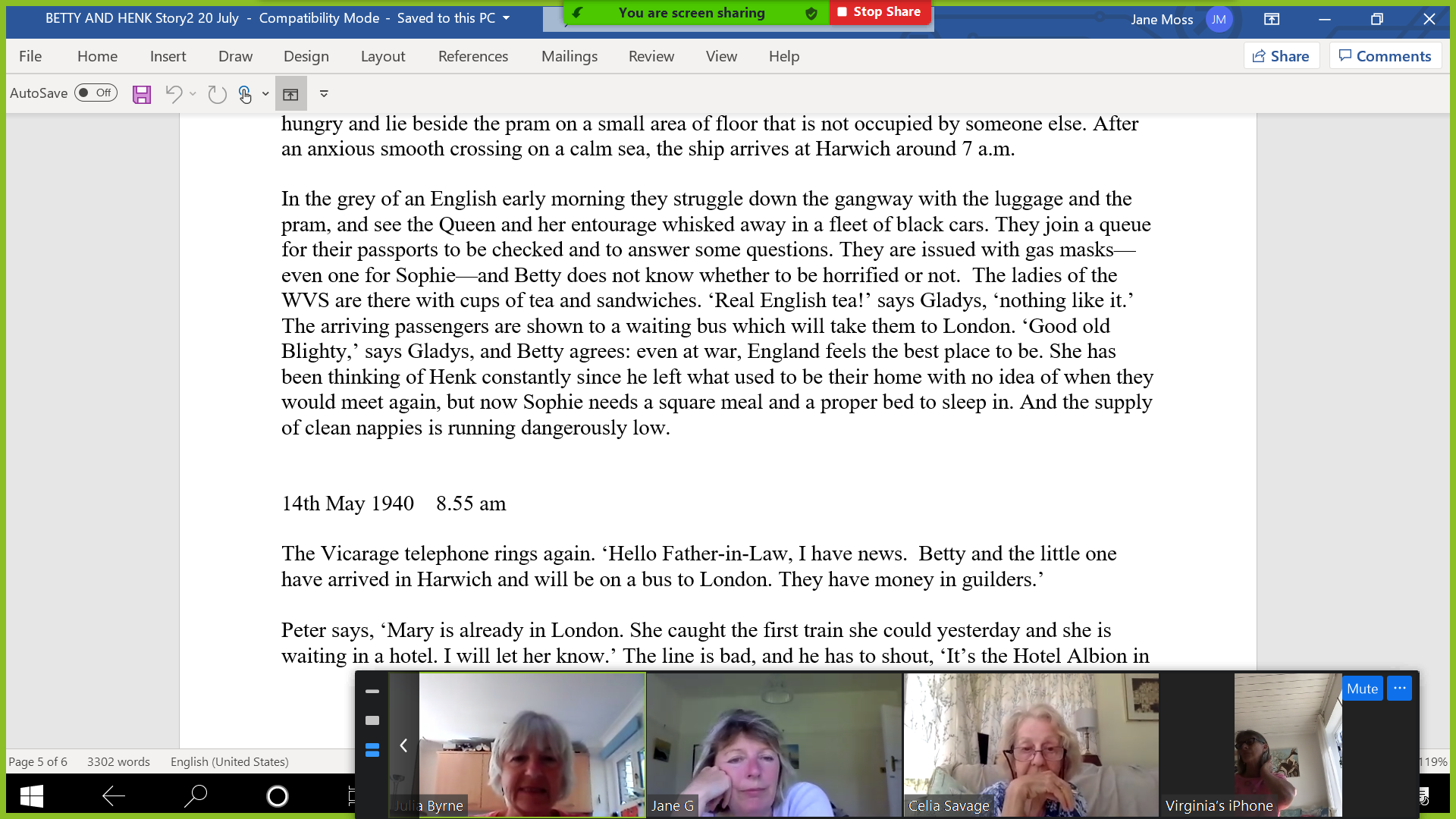
During lockdown the Joined Up Writers have not been idle. Quite the contrary: as soon as we became confined to our own homes we found a way to work together online through the video platform Zoom. Here are six things we’ve learned from gathering together each week since the beginning of April.

  1. It’s really quiet and private in here, just us, getting on with the novel. There are no interruptions, just the occasional bark from Barny the dog and some helpful interjections from family members in the background. Zoom’s waiting room system means that no can come into our room but us.
  2. We’ve speeded up. With more time to work on the novel, and a little less chat in the Zoom room than we would normally enjoy when we meet face to face, the novel is motoring ahead. We’ll be publishing more on this site soon.
  3. It’s fun to meet on Zoom. We’ve done some new things including a sort of role play for a scene which is coming up soon, and we’ve been sharing ideas, pictures and draft writing on screen. Zoom is very ‘user-friendly.’
  4. It can be hard to hear everyone when the audio is dodgy or someone is having wifi problems. We’ve become used to muting and un-muting ourselves and we do our best not to interrupt.
  5. It brings us together in a way we couldn’t have done without during this time. When the lockdown started it simply wasn’t an option to stop. Zoom gave us the means to carry on. It wasn’t easy at first, not everyone could work Zoom but we  got the hang of it with help from each other and others outside the group.
  6. We miss ‘real’ meetings and we hope to be able to get together soon for an outdoor writing session in someone’s garden. Zoom is a great alternative but it isn’t a substitute. In future we shall probably do a bit of both, online and in ‘real life’.

Stay tuned for more instalments of Trevow.

What’s in a name?

Cornish speakers may spot the significance of the novel’s name, Trevow. How does an author decide what to call their work? Some people start with a title in mind. Others hold on until they have finished a draft before the title comes to them. In our case, with multiple authors all with ideas of our own, we had a list of suggestions. They included characters’ names, events and hints about the story, some of them humorous and others mysterious, but we kept coming back to the novel’s theme which is ‘home’.

We were reminded of stories that bear the name of the place in which they are set; stories in which the setting is almost a character in the drama: Mrs Gaskell’s Cranford, George Eliot’s Middlemarch and Dylan Thomas’s Under Milkwood, for example.

Everyone in our story is affected by ‘home’, whether or not they have one or are seeking one. Trevow sums it up.

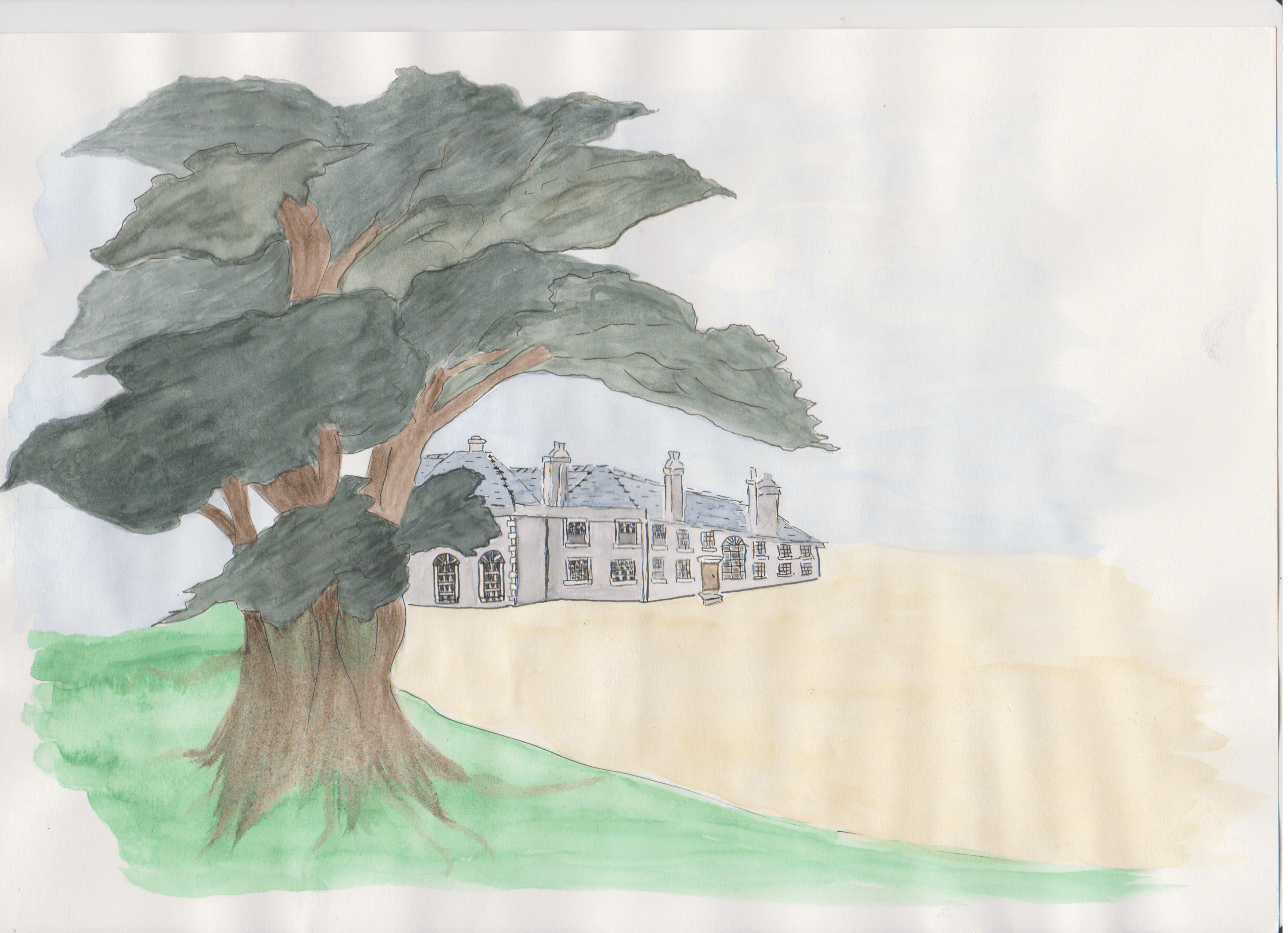
Here is an artist’s impression of the grand house, Tregethlan, that is home to our characters Anneke and Margaret. Thank you to Servane Trefusis for letting us use her painting of the old house and its great cedar tree, which will occur again later in the story.

Chapter 3: an experiment with WhatsApp

The Joined Up Writers are delighted to share Chapter 3 of our community novel, in which we meet a new character, Valerie, later in the evening on the day of the fair. Valerie has come to the village to house hunt but has found herself tangled up in the strange and tragic events of the day. Sitting in the kitchen of Tregethlan Manor she has a conversation with her husband Derek on their WhatsApp family group, but is interrupted.

The dialogue between Valerie and Derek towards the end of the chapter was originally written by two of the Joined Up Writers in WhatsApp, complete with emojis, exclamation marks and predictive texting. We have decided not to correct the words that came out scrambled (as they often do in texts), but to leave it as it came out.

We hope you enjoy reading our latest chapter.

Read the Prologue and Chapter 1

Here it is. After months of planning, drafting and re-writing, we are delighted to share the Prologue to our as yet un-named novel, and Chapter 1. Chapter 2 is nearly ready and we will share that in the next few weeks.

We would love to hear your comments. At the foot of each page you will see a box in which you can leave us a message ask questions and even make suggestions. You can chat to us on Facebook as well.

The novel is the work of a dedicated group who meet once a week, and contributions and inspiration gleaned from many others in the local community. If you saw us at the Mylor May Fair in summer 2019 you may have answered our request for ideas about where you would take shelter in storm. That dramatic scene will come later in the plot, but you will see the effects of a sudden rain shower in Chapter 1, an event that foreshadows greater weather events to come.

As you read, look out for links from the text to some hidden items. These will be added to as our story develops but you can see the first one here, a short poem written by nine Joined Up Writers to capture the meaning ‘home’ can have for different people. That will be a big theme in the story.

The story is entirely fictional and any resemblance to people and places you know locally is a coincidence, although it is fair to say that the writers are inspired by what they know as people who live in this area or have strong local connections to it. It is being written with a great deal of attention to detail.

We hope it will move and entertain you, and we hope you enjoy reading it.

Let the re-writing begin!

A few years ago The Guardian newspaper asked some famous writers about their routines. Michael Frayn, playwright and novelist, had this to say: In my case I look back over what I was doing the day before and make a few small corrections, often to typing errors, then maybe a few grammatical errors, and then I see a better way of putting something, and gradually you get drawn into the world you’ve created and you start rewriting what you did the day before…”

Novelist Michael Holroyd said: “What I really like is rewriting, but you cannot rewrite until you’ve already written, and that is terrible. And then rewriting the rewritten text, and so on, up to 10 times, hoping always to get it shorter, more condensed, pack more energy into it… You have the energy from the first draft, the momentum, the “go”, but then you try to shape it more.”

Both of them are saying that writing means re-writing. No one should ever expect to write a story just once; it takes many drafts and – crucially – willingness by the writer to go over and over what they have already put down on paper. It means reading what you have already done with fresh eyes and re-writing it until it is the best it can be.

That is where we are with the community novel which we began work on almost a year ago. After weekly meetings stretching back to autumn 2018 we have the ‘messy first draft.’ It is stored in word documents, some it in DropBox, and in a big concertina file, the sort a lawyer or accountant uses to keep documents in correct order.

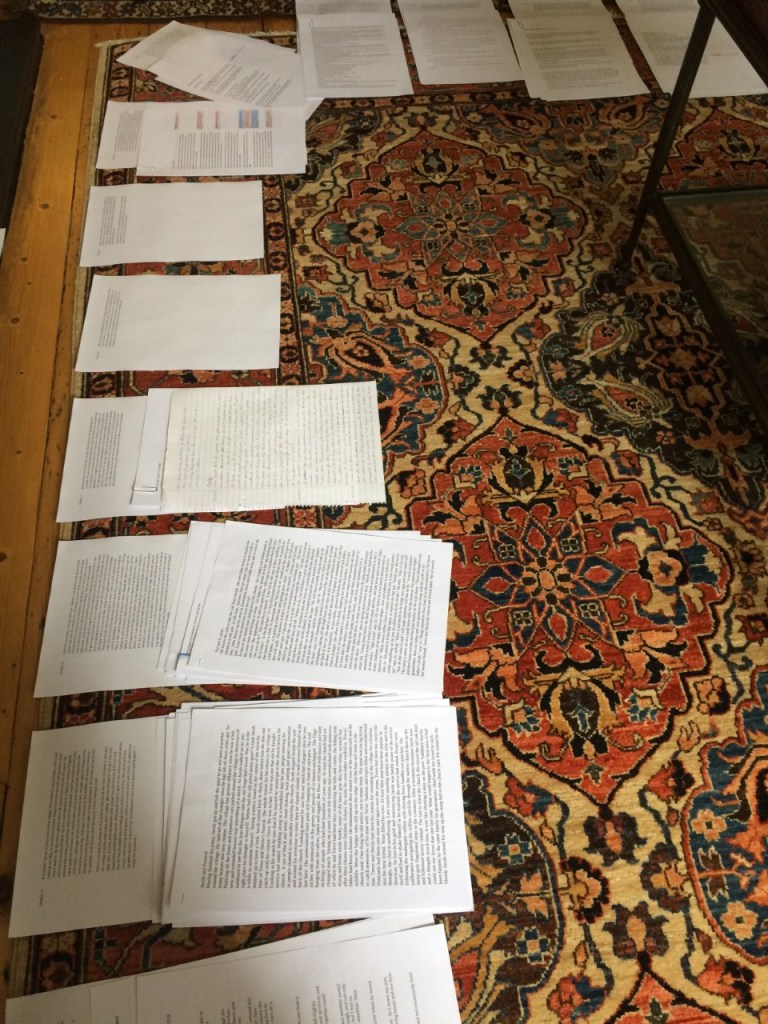
Our drafts cover the carpet

Over the summer Jane, who is guiding the process, spent several weeks sorting through it all. She sifted through hundreds of emails, attachments, handwritten sheets from our weekly meetings, and pieces of paper put through her door or even slipped into her bag while she wasn’t looking. The writing we have done so far is complemented by a growing collection of photographs taken on smart phones and iPads. We have records of writing sessions in which we have mapped out our entire story with plot points and a detailed ‘back story’, and sheets that describe the personality of each of our central characters.

Joined Up Writers in the cafe at Mylor Harbour

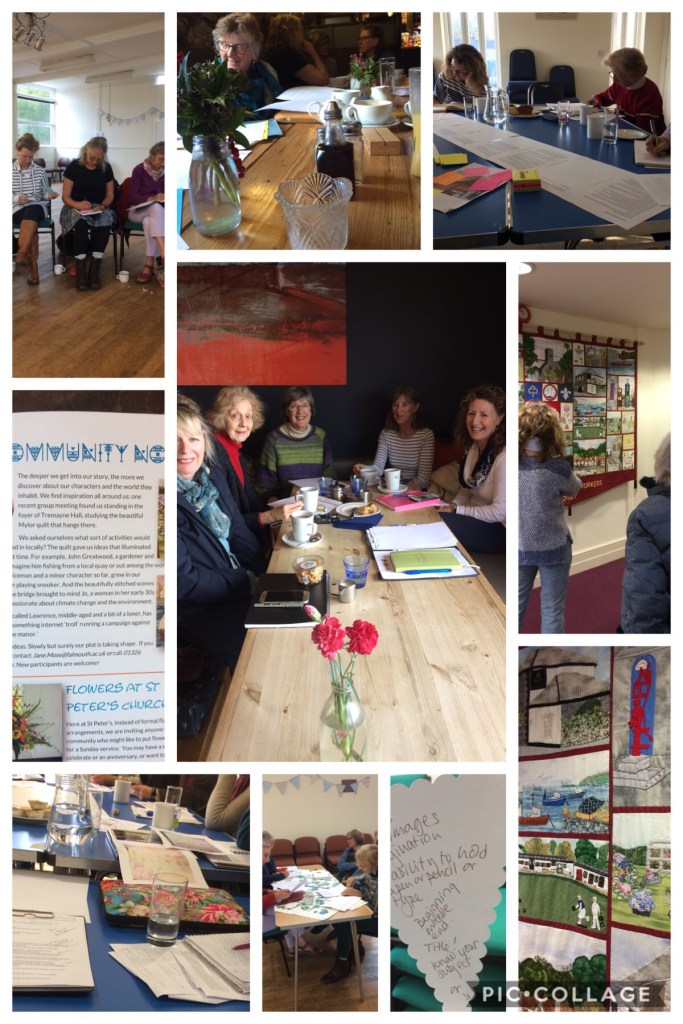
It’s an achievement to have got this far. We’ve been writing in various locations around the parish: Tremayne Hall, Mylor Harbour Café, Flushing Sailing Club, the Lemon Arms, The Pandora Inn, and the community garden behind All Saints Church in Mylor Bridge. We have thrashed out our story and now we are ready to polish it.

Bear with us while we work on our opening scenes; we will be back here soon with the first installment.  

What does ‘home’ mean?

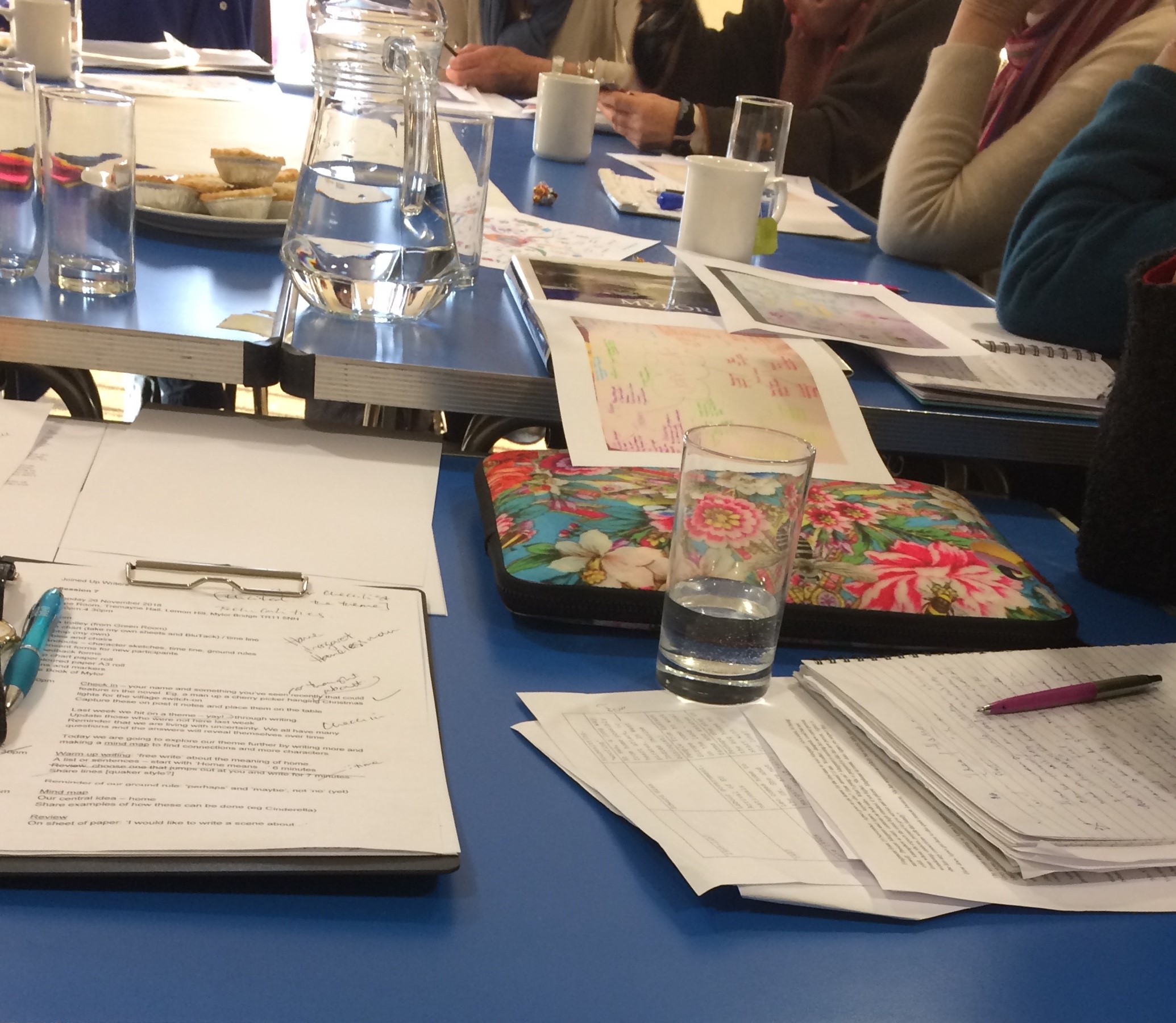
Elbows on the tableAs we develop characters for the community novel we have been looking for a theme, a unifying idea to unite then all, from which we can weave threads of story.  We found it when we shared the results of a short writing exercise at the end of a long discussion about what might connect our characters, and how they each experience the community in which our story will be set.

This is what emerged:

A man drinks on a bench on the playing field. A woman walks her dog and sees him. Feeling alone and afraid she heads to the boatyard where there are people around. She alerts them. He may be the man spotted sleeping in the churchyard.

A woman walks beside the creek. She meets people coming the other way, walking their dogs. She has noticed that everyone seems to have a dog here. She is looking for a house to buy, does not know the area but wants to know what it would be like to live here.

A homeless man arrives as the Christmas lights are switched on. He has walked through fields of winter wheat and encountered a farmer.

A woman, Margaret, walks on a mizzly morning. Her mother-in-law with whom she does not get on has Great Danes, she has a dashchund, Wolfgang. John Greatwood has recently started working for her as a gardener. She is busy, involved in village fundraising events. ‘Glamour had always motivated Margaret’.

A meeting of the Parish Council takes place, held at the village school, a planning meeting about new housing with provision for homeless and local people who can’t afford local prices. Margaret becomes very vocal about preserving the beauty of local landscapes. She and her estranged daughter Jo have a public confrontation.

On May Fair Day children dance around the May pole and there is a bouncy castle, music and stalls: a scene in which all the characters can come together.

Hearing these glimpses we recognised that what holds them together is the theme of home; what it means to have a home, seek a home, lose a home, not be able to afford a home, find a new home, or not have a home.

We wrote more about this and made a single short piece:

Home means a safe haven

A loving dog to greet me when I return home

Home is a sense of belonging, an identifying with a place that formed our beginnings

Not feeling walled in against the world but an open door to the world

Living with beloved people, a landscape you understand,

Objects with memories, comfort, security, caring,

A place that I can call my own.


Finding yourself on the outside looking into other people’s sitting rooms,

You on the pavement in the cold

Home sounds, home echoes, reverberates, cuts and hurts


Home is central heating and a comfortable bed,

Home is where one lays one’s head,

A safe haven where you can be yourself.


Everyone’s voice in a unified set of lines, shared ‘Quaker style’ after a free write in response to the question ‘what does home mean.’

A set of words to anchor us to our theme, perhaps.

A letter to the digital age

Dear Digital Age

I can remember a time before you, when there was one typewriter in the office and we booked time on it, when I saw my first fax being received in an editorial office and thought ‘this will speed things up’, when I arrived on my first day at a new job as a copywriter and found a giant word processor sitting on my desk. I had to ask how to switch it on.

We learned quickly in those days (it was the late 80s). Technology came at us in a rush; suddenly we were networked, emails pinged back and forth between people in the same building, even the same room. I worked in central London in an office that published a fortnightly listing for West End theatres. We were used to couriers arriving by bike to deliver proofs, discs and hard copies of images, but now they stopped, replaced at first by emails and scanners and later by Web 2.0 which meant file sharing and interaction. Everything speeded up even more.

It was clunky for a while. I remember crouching beside my desk, coaxing the Pipex dial-up into life so that we could use the web. There were new wires to trip over, new bleeps and hums from desktops, and repeat strain injury which some of us aquired by typing too fast, too much and in the wrong position on desks and chairs not designed for the hunched intensity of the computerised office.

About 12 years ago, a young colleague of mine asked how we had accessed the internet before everyone had computers on our desks. We told him we had coped just fine. Now, I am struck by the difference you – Digital Age – have made as I gradually introduce digital media to the running of writing groups in places like community centres and village halls, places that do not necessarily have efficient wifi or even (in rural Cornwall) much of a mobile phone signal.

Pinterest image for blog 2It strikes me too that the ‘digital natives’ who have grown up with smart phones in the palms of their hands, and laptops in every class room, would be lost without their easy access to all things web. They would have to reinvent the way they work as I am reinventing mine now. What have I noticed so far?

Apps are fun, expecially when you use them for purposes other than the ones they were designed for. More on this is a future blog…

Social media is too wide open for what is a group activity by a specific community of people. I am learning how to set up secret and private groups, which feel counter-cultural in terms of how Facebook, Instagram and others were intended to be used.

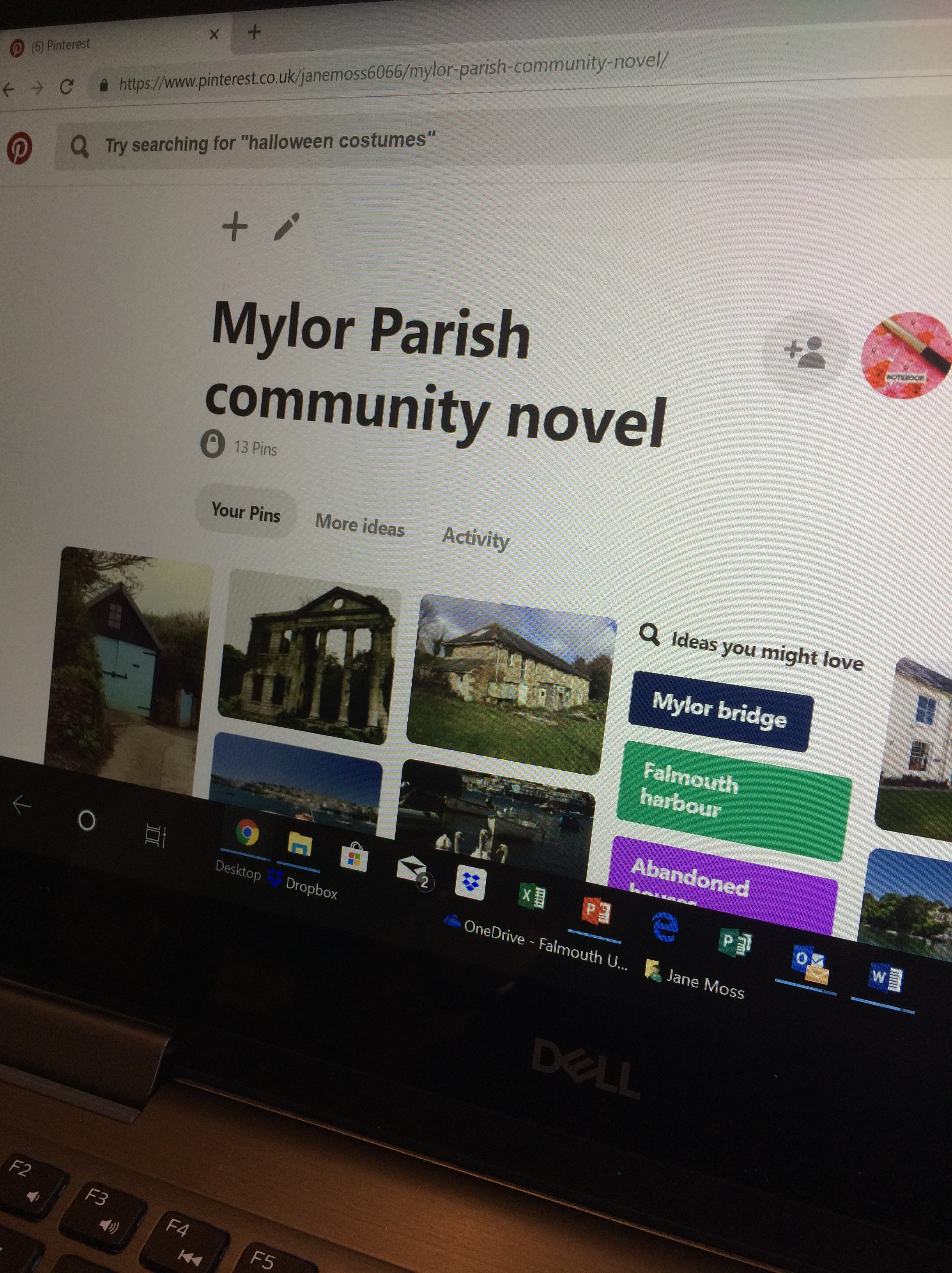
Some people are bemused by the social media others take for granted. Because I remember a time without it, I do not assume that people know what I am talking about when I suggest we use, say, Pinterest to build up a picture of a setting or a character.

Digital media takes time to set up. My preparation time in the rooms where I host writing groups has doubled. I can no longer arrive with 30 minutes to spare, set up tables and chairs, boil the kettle and set out the cups, then enjoy 10 quiet minutes with my notes, printed handouts and reading materials.

It’s heavy too. I have to carry the laptop, unpack the projector, set up the screen, plug everything in and test it, and check the wifi is working. In the room where I currently host a regular weekly session it doesn’t, but I am able to pick it up via a neighbour’s open access account.

Despite that, I am enjoying it when it goes well; I can see my toolkit expanding and I like the challenge of thinking up new ways to use the digital, and ways to combine it with traditional methods so that no one is excluded.

Thank you for that, Digital Age.

We’ll talk again soon.

First steps to a community novel

I spoke to author Jen Alexander in early August; we were talking about writing groups, the pros and cons of running them and the magic that can happen when a group of people gather to write in the same room. Jen put it beautifully when she said ‘As soon as people sit down around the table to write you have a community.

This idea of mine, to see if a group of people can write something as sustained and complex as a novel, what that might look like as a process, what it might mean to the people who write it, and the communities they belong to, was an itch I needed to scratch.

Funding from the AHRC has made it possible, with a place on Falmouth University’s 3D3 programme. Now I feel like the living embodiment of the warning ‘be careful what you wish for,’ but in a good way.

I have the luxury of three funded years in which to test my notions of a community of writers, readers and researchers collaborating on a work of long fiction; writers who are not professional, not published, but passionate about creative writing as something they love in the way other people love sport or art or music; activities that bring people into contact with each other to make something and, in the making, make more than just the fiction; make connections, make friends, make new images of the place – the community – they share.
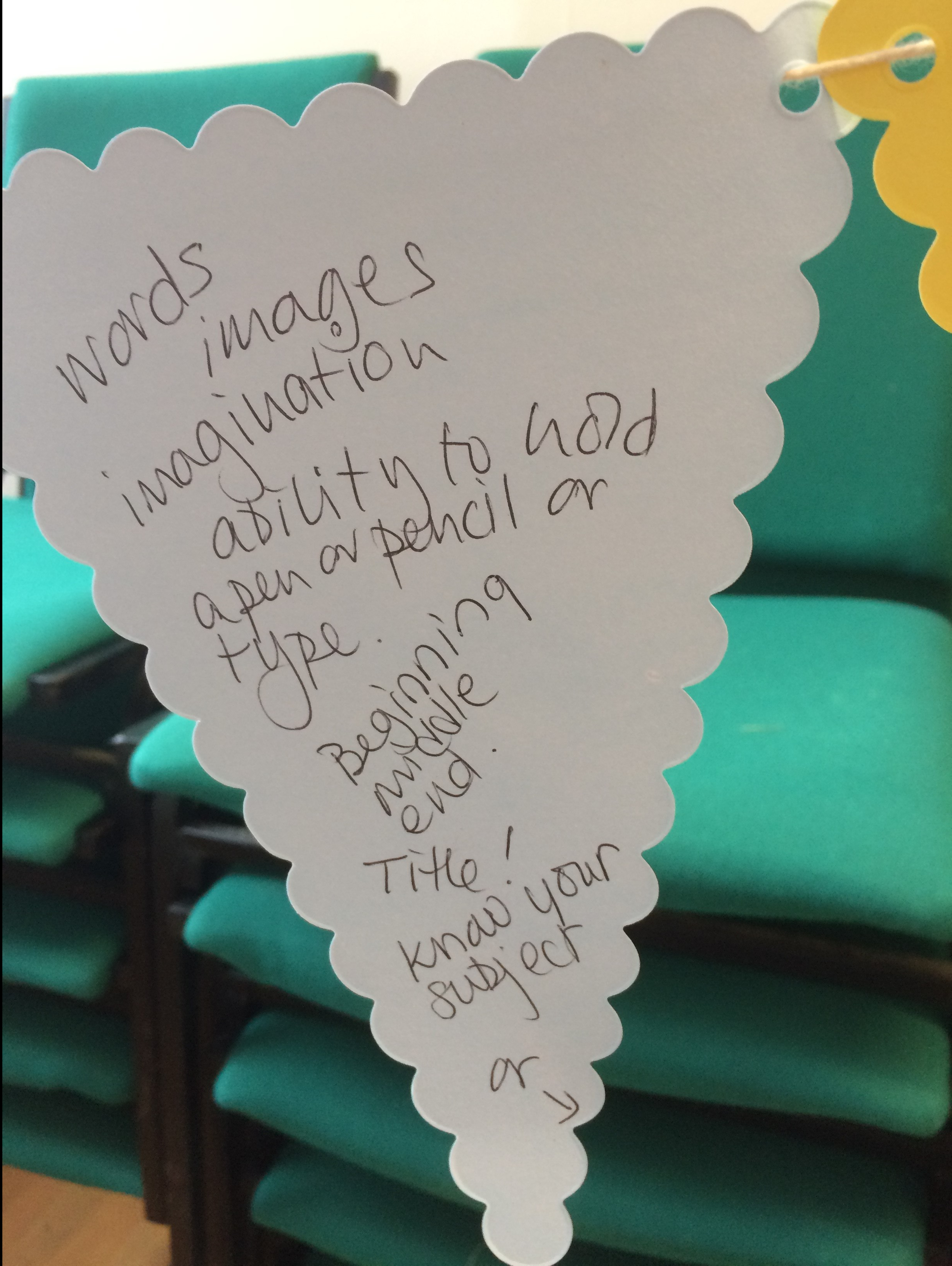
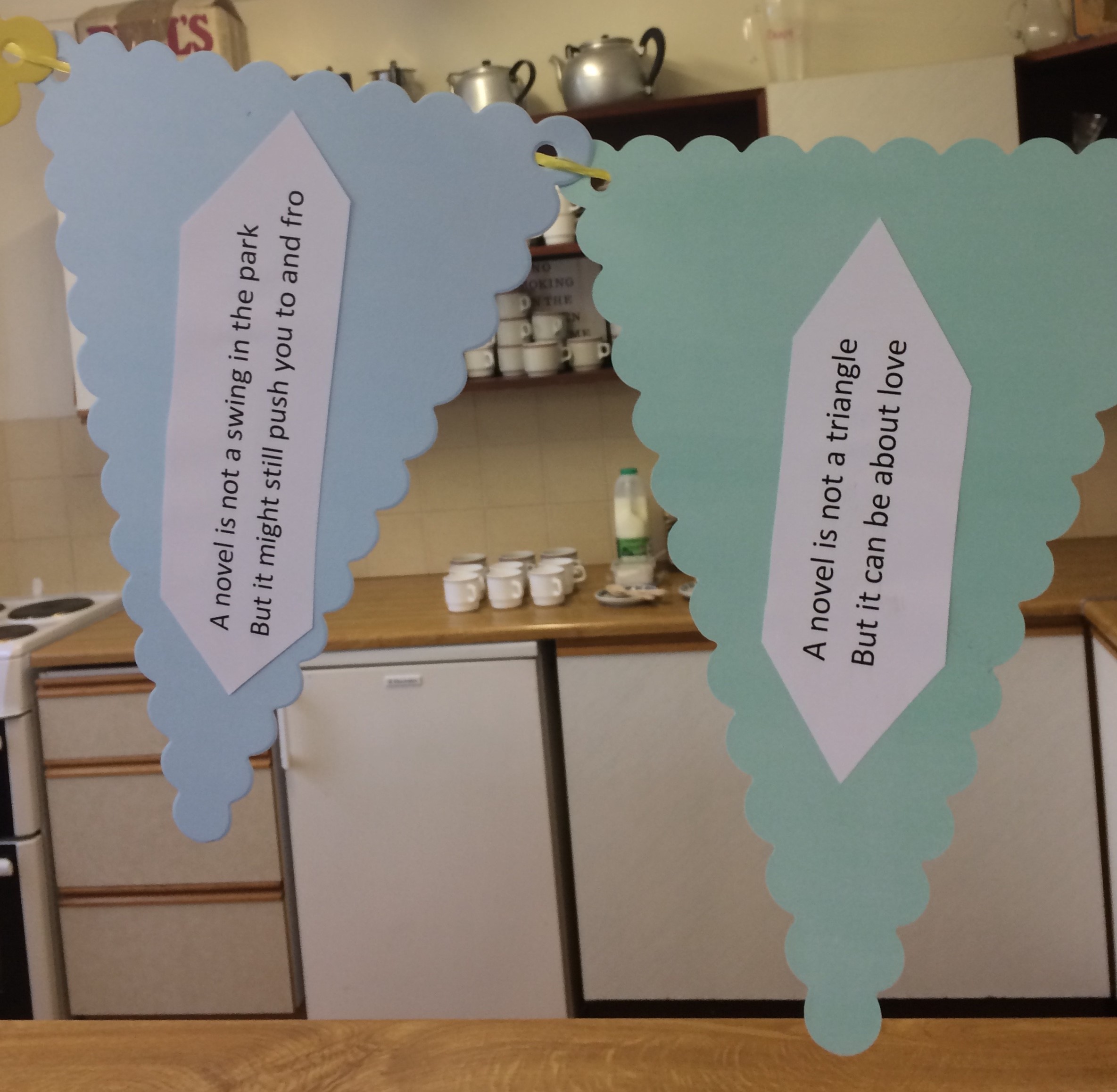
Novel bunting 1On 22 September 2018, after some planning and publicity, I welcomed the first participants to an echoey community hall, the Ord-Statter Pavilion in Mylor Bridge on the south Cornwall coast. It was a grey Saturday. Outside the rain came down in sheets; inside we clustered in the large hall and shared ideas about what it takes to write a novel: characters that compel, settings that are authentic, powerful descriptive language, strong narrative, a plot that drives forward with a clear, consistent voice. We hung our ideas on a line of bunting.

We asked what a novel can be in the 21st century: print, online, graphic, digital, We looked at examples of novels written by more than one person. Could we see the join?

Then we started to write together, 8 voices woven into one through the form of an alpha poem. I thank Fiona Hamilton and the Orchard Foundation for leading me to John Hegley’s poem What a Poem’s Not, as our model.

This is What a Novel’s Not, by Annie, Barbara, Carole, Caroline, Isabel, Jane, Joanna and Kim.

A novel is not an ambulance driver

But it might still save your life

A novel is not a bear

But sometimes it can give you a hug

A novel is not a clue

But it might help you on its way

A novel is not a dam

But it can contain the deepest reservoir of human experience

A novel is not exhausting

But it can feel like it!

A novel is not a ferryboat

but it may take you across some turbulent waters

A novel is not always ground breaking

It can simply hold you

A novel is not a haunting

But it may spook your mind

A novel is not an ironing board

But it can slowly unfold

A novel is not a judicial review

But it still might have a sense of fair play

A novel is not a knot

But it can get me all tangled up

A novel is not always about love

But love is always there

A novel is not a miracle

But finishing a novel might feel like one

A novel is not a negative experience

But can be sometimes

A novel is not an orange

but it can sometimes get very juicy

A novel is not pretentious

It can draw you in like a fish

A novel is not a quiz

But it may question your beliefs

A novel is not a river

But it can flow in twists and turns

A novel is not a swing in the park

But it might still push you to and fro

A novel is not a triangle

But it can be about love

A novel is not an umbrella

But it could shade you from the sun and the rain

A novel is not a vandal

Though it can wreak havoc

A novel is not a waste of time

But an experience

A novel is not always Xanadu

But it can be for some people

A novel is not a yawn

It shouldn’t send you to sleep

A novel is not a zoo

But it may contain some strange creatures.

We have started to be joined up writers.  Poem bunting