Notes from the pandemic

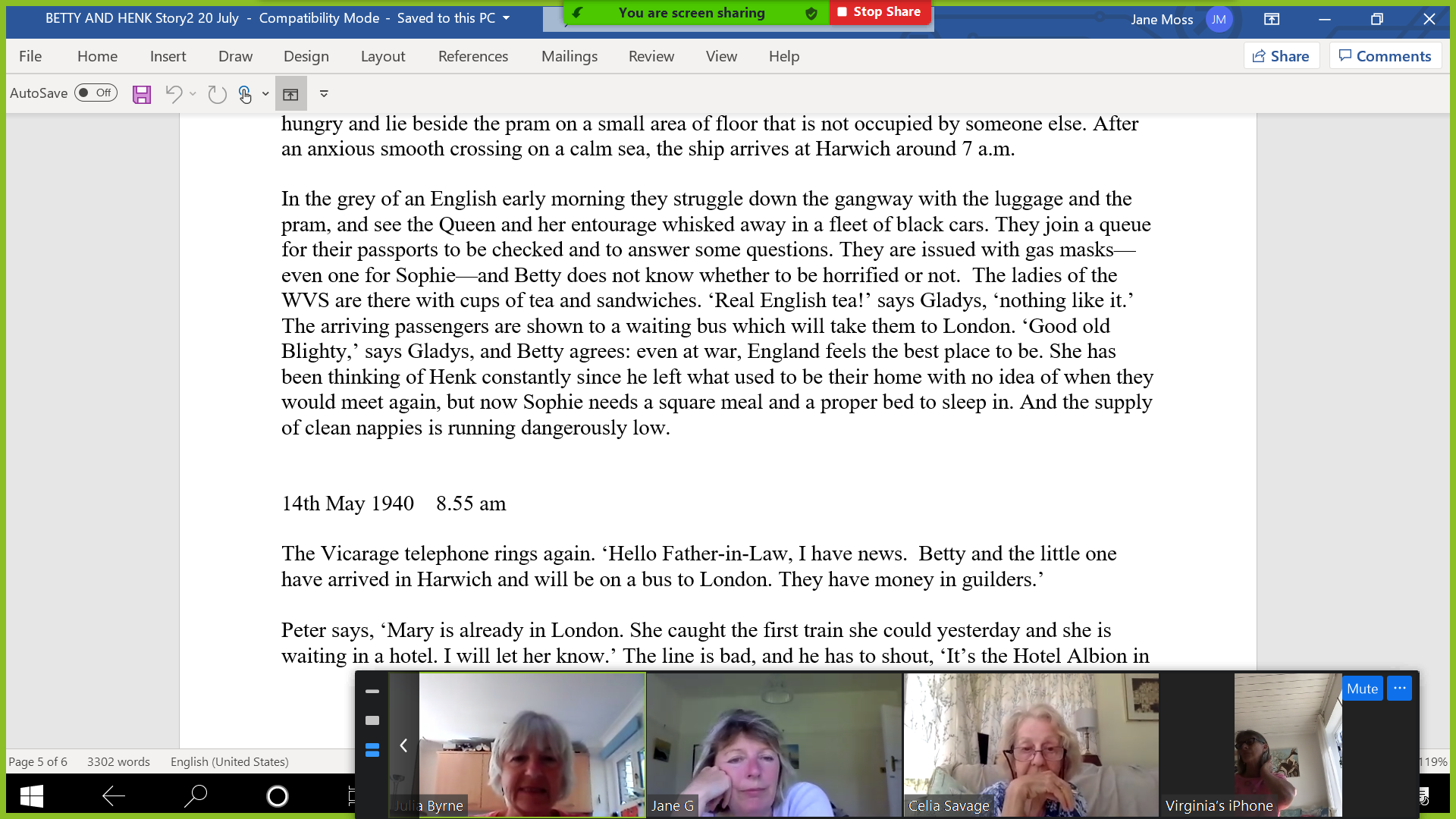
During lockdown the Joined Up Writers have not been idle. Quite the contrary: as soon as we became confined to our own homes we found a way to work together online through the video platform Zoom. Here are six things we’ve learned from gathering together each week since the beginning of April.

  1. It’s really quiet and private in here, just us, getting on with the novel. There are no interruptions, just the occasional bark from Barny the dog and some helpful interjections from family members in the background. Zoom’s waiting room system means that no can come into our room but us.
  2. We’ve speeded up. With more time to work on the novel, and a little less chat in the Zoom room than we would normally enjoy when we meet face to face, the novel is motoring ahead. We’ll be publishing more on this site soon.
  3. It’s fun to meet on Zoom. We’ve done some new things including a sort of role play for a scene which is coming up soon, and we’ve been sharing ideas, pictures and draft writing on screen. Zoom is very ‘user-friendly.’
  4. It can be hard to hear everyone when the audio is dodgy or someone is having wifi problems. We’ve become used to muting and un-muting ourselves and we do our best not to interrupt.
  5. It brings us together in a way we couldn’t have done without during this time. When the lockdown started it simply wasn’t an option to stop. Zoom gave us the means to carry on. It wasn’t easy at first, not everyone could work Zoom but we  got the hang of it with help from each other and others outside the group.
  6. We miss ‘real’ meetings and we hope to be able to get together soon for an outdoor writing session in someone’s garden. Zoom is a great alternative but it isn’t a substitute. In future we shall probably do a bit of both, online and in ‘real life’.

Stay tuned for more instalments of Trevow.
Chapter 3: an experiment with WhatsApp

The Joined Up Writers are delighted to share Chapter 3 of our community novel, in which we meet a new character, Valerie, later in the evening on the day of the fair. Valerie has come to the village to house hunt but has found herself tangled up in the strange and tragic events of the day. Sitting in the kitchen of Tregethlan Manor she has a conversation with her husband Derek on their WhatsApp family group, but is interrupted.

The dialogue between Valerie and Derek towards the end of the chapter was originally written by two of the Joined Up Writers in WhatsApp, complete with emojis, exclamation marks and predictive texting. We have decided not to correct the words that came out scrambled (as they often do in texts), but to leave it as it came out.

We hope you enjoy reading our latest chapter.

Let the re-writing begin!

A few years ago The Guardian newspaper asked some famous writers about their routines. Michael Frayn, playwright and novelist, had this to say: In my case I look back over what I was doing the day before and make a few small corrections, often to typing errors, then maybe a few grammatical errors, and then I see a better way of putting something, and gradually you get drawn into the world you’ve created and you start rewriting what you did the day before…”

Novelist Michael Holroyd said: “What I really like is rewriting, but you cannot rewrite until you’ve already written, and that is terrible. And then rewriting the rewritten text, and so on, up to 10 times, hoping always to get it shorter, more condensed, pack more energy into it… You have the energy from the first draft, the momentum, the “go”, but then you try to shape it more.”

Both of them are saying that writing means re-writing. No one should ever expect to write a story just once; it takes many drafts and – crucially – willingness by the writer to go over and over what they have already put down on paper. It means reading what you have already done with fresh eyes and re-writing it until it is the best it can be.

That is where we are with the community novel which we began work on almost a year ago. After weekly meetings stretching back to autumn 2018 we have the ‘messy first draft.’ It is stored in word documents, some it in DropBox, and in a big concertina file, the sort a lawyer or accountant uses to keep documents in correct order.

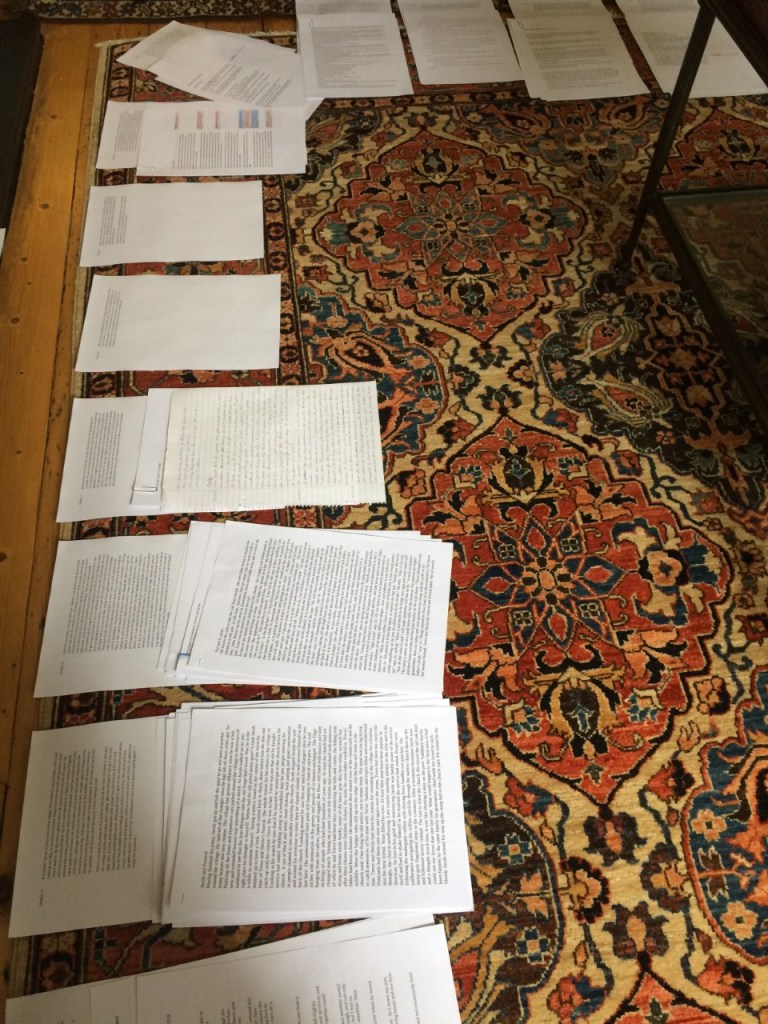
Our drafts cover the carpet

Over the summer Jane, who is guiding the process, spent several weeks sorting through it all. She sifted through hundreds of emails, attachments, handwritten sheets from our weekly meetings, and pieces of paper put through her door or even slipped into her bag while she wasn’t looking. The writing we have done so far is complemented by a growing collection of photographs taken on smart phones and iPads. We have records of writing sessions in which we have mapped out our entire story with plot points and a detailed ‘back story’, and sheets that describe the personality of each of our central characters.

Joined Up Writers in the cafe at Mylor Harbour

It’s an achievement to have got this far. We’ve been writing in various locations around the parish: Tremayne Hall, Mylor Harbour Café, Flushing Sailing Club, the Lemon Arms, The Pandora Inn, and the community garden behind All Saints Church in Mylor Bridge. We have thrashed out our story and now we are ready to polish it.

Bear with us while we work on our opening scenes; we will be back here soon with the first installment.  

What does ‘home’ mean?

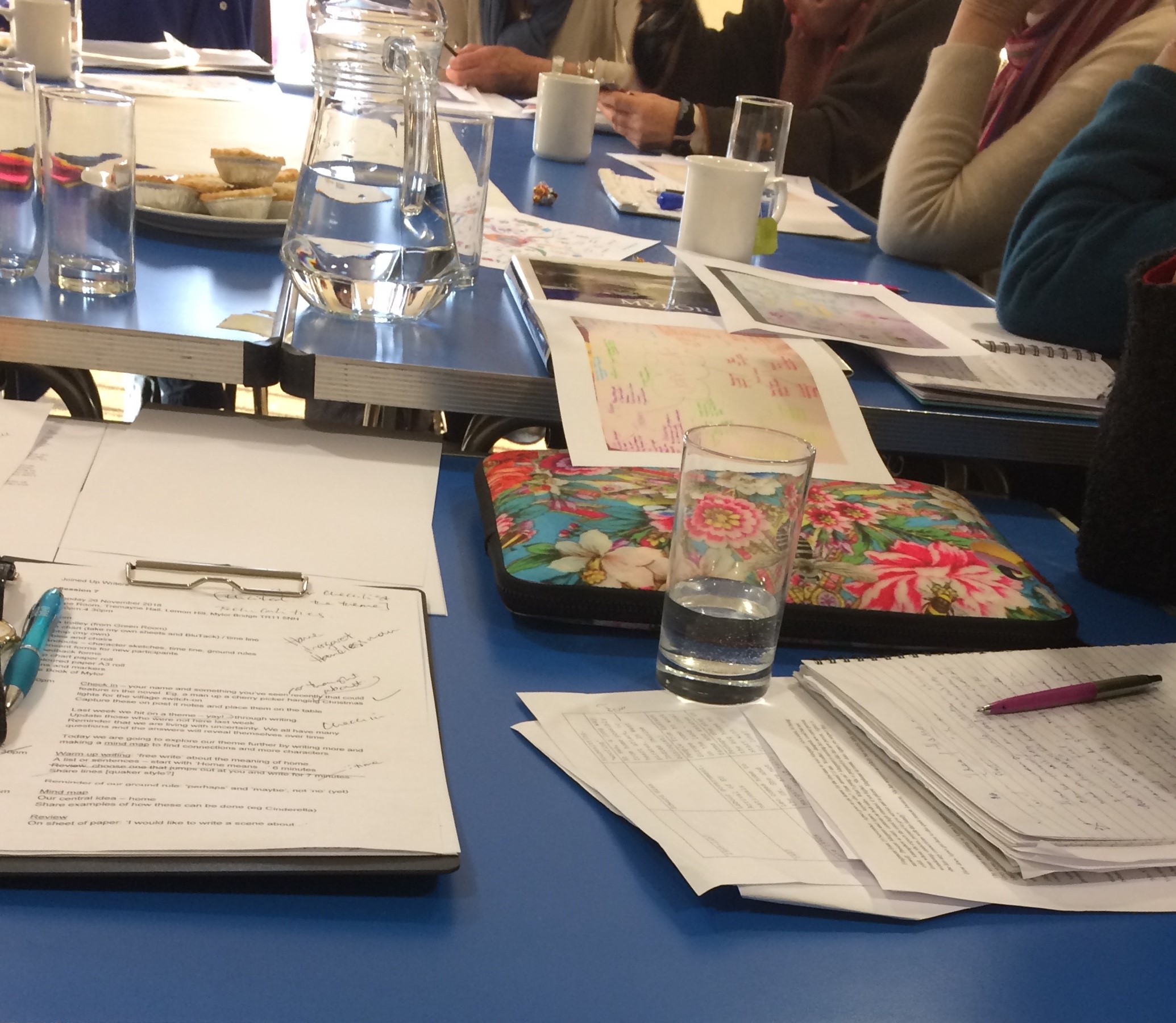
Elbows on the tableAs we develop characters for the community novel we have been looking for a theme, a unifying idea to unite then all, from which we can weave threads of story.  We found it when we shared the results of a short writing exercise at the end of a long discussion about what might connect our characters, and how they each experience the community in which our story will be set.

This is what emerged:

A man drinks on a bench on the playing field. A woman walks her dog and sees him. Feeling alone and afraid she heads to the boatyard where there are people around. She alerts them. He may be the man spotted sleeping in the churchyard.

A woman walks beside the creek. She meets people coming the other way, walking their dogs. She has noticed that everyone seems to have a dog here. She is looking for a house to buy, does not know the area but wants to know what it would be like to live here.

A homeless man arrives as the Christmas lights are switched on. He has walked through fields of winter wheat and encountered a farmer.

A woman, Margaret, walks on a mizzly morning. Her mother-in-law with whom she does not get on has Great Danes, she has a dashchund, Wolfgang. John Greatwood has recently started working for her as a gardener. She is busy, involved in village fundraising events. ‘Glamour had always motivated Margaret’.

A meeting of the Parish Council takes place, held at the village school, a planning meeting about new housing with provision for homeless and local people who can’t afford local prices. Margaret becomes very vocal about preserving the beauty of local landscapes. She and her estranged daughter Jo have a public confrontation.

On May Fair Day children dance around the May pole and there is a bouncy castle, music and stalls: a scene in which all the characters can come together.

Hearing these glimpses we recognised that what holds them together is the theme of home; what it means to have a home, seek a home, lose a home, not be able to afford a home, find a new home, or not have a home.

We wrote more about this and made a single short piece:

Home means a safe haven

A loving dog to greet me when I return home

Home is a sense of belonging, an identifying with a place that formed our beginnings

Not feeling walled in against the world but an open door to the world

Living with beloved people, a landscape you understand,

Objects with memories, comfort, security, caring,

A place that I can call my own.


Finding yourself on the outside looking into other people’s sitting rooms,

You on the pavement in the cold

Home sounds, home echoes, reverberates, cuts and hurts


Home is central heating and a comfortable bed,

Home is where one lays one’s head,

A safe haven where you can be yourself.


Everyone’s voice in a unified set of lines, shared ‘Quaker style’ after a free write in response to the question ‘what does home mean.’

A set of words to anchor us to our theme, perhaps.